Diachronic Newsletter Literary Agent Lauren Khan
Fall 2026
Trench Foot
Volume 2
Lewis Henry Martin’s Diachronic Newsletter
Headline
The Sandbox
Six Words To Story 2026
Given the participation and fun everyone had with this event, we’re certain that everyone joins us expressing…
Congratulations to:
Oldman Turtle
The chosen prompt:
“For that was an old turtle”
There were 3 runners up:
“Cute hamster, fluffy dog: friends forever”
“Cute dog, baby bird, funny hamster”
We’ll tell you two secrets…
First; there may have been a truly wonderful story written about a young girl who found herself as the caretaker of a magical animal shelter. And if Mr. Martin weren’t such a stickler to the rules you might be reading it. He couldn’t separate these two entries in his mind, nor the resulting story. Alas, the rules stipulated, only one could be chosen. He remarked, “…maybe I’ll just send those authors that story anyhow; just for each of them.”
The second secret pertains to the third of the runner up’s submission…
“Procrastination is the cause oh s#!t”
This submission resulted in a wild story that opened;
Dorothy Baxter and her friends, Ethel Terry, and Hazel Kurtzel, have resided in [a particularly green gem] City for some years now. The upscale assisted living facility was commissioned and now co-owned by the three women.
The story is a parody of a particularly famous story and subsequent movie about a girl and her dog trying to get back to her home (you know the one). But let me tell you, the subtle, legal distinction between parody and satire is one copyright tightrope that Mr. Martin dares not to walk. Unfortunately, this story must remain sealed until December 31, 2034. Set yourself a reminder.
An honorable mention:
“Final Dance. Two left feet fixed”
This submission could have run away with it. If it weren’t for the fact that it ran in so many directions at the same time. This submission is filled with endless story and deserves mention –it deserves stories, but limiting it to just one?! Ridiculous.
Before you read [The Pathos of Things] the story I wrote about the chosen six words, “For that was an old turtle”, I’d like to express my appreciation for everyone’s participation and especially for your remarkable creativity.
No one of your submissions were any less important than the next, and limiting myself to only one required immense restraint. I take tremendous joy sharing in your creative expressions and endeavors. I’m so very excited to read all your wonderful stories that you’ll be submitting to Craft Your Castle!
PS: Next time, let’s agree to do this more democratically. I would much rather everyone have a say in the decision.
Until then,
Lewis Henry Martin
The Pathos of Things
For that was an old turtle; now we are but three.
The muskrat, the eagle, and the smarmy bumblebee.
For that was an old turtle; I beg of you, acquire,
He was ever-so beloved, our esteemed and greatest grandsire.
An extraordinary title of odd consanguineous;
Given our peculiar origins, and our apparent thingy-thingness.
If you would imagine us, we’re creatures, numbering three;
The muskrat, the eagle, and that smarmy bumblebee.
No line, no length, no place we occupy;
Barring the endless and the infinite limiting figments of your eye.
You see, for story or for fiction, or for tales that need be told,
It’s introspects compartments, save our characters’ you must hold.
Whether fleeting or ephemeral, or salience set long term,
Our duration; our existence; our contingency you affirm.
So, endeavor; let me tell you, of these creatures numbered three,
And of the myth, the tale, the legend, of the fabled storied tree.
But keep in mind the turtle, I beg you understand,
He lay beneath our very feet; fashioned firmament; reality and land.
Indebted to his sacrifice, is our reality’s existence,
Manifestly consequence of his indominable persistence.
Back so very long ago, when ancients were but new,
Back before the nothingness became skies of solid blue.
There had always been a turtle, a single thingness entity,
A magic turtle of conviction; imbued with fate and destiny.
He pulled the very water for the entirety of the Earth,
From beneath the shell upon his back, and there, gave life its birth.
But sand and soil and planting seeds were yet commodities,
There was no Earth to grow upon, just vastly fathomed seas.
So he made the noble muskrat then, and set him to submerge,
“Don’t return with clay in hand, it’s loamy dirt that I urge!”
Triumphant was the rodent, who returned with precious soil,
But an obstacle awaited them, a task which neither one could toil.
So he made the regal eagle bird, who could search the skies afar,
“The sprout requires nourishment; gather potash; or even feldspar!”
To this day a mystery; where the eagle flew is lore,
Some place that we may never know; but success, he brought us ore.
But a growing plant still bears no fruit; lacking pollen, there’s no tree.
So the turtle made a thingness-thing, and hark, the smarmy bumblebee.
Now, I try to never-ever, judge a book for what’s its cover,
But bothersome his buzzing is; in your ear, he’d bumble-hover.
And if you took a swat at him, he’d give you quite a sting,
Such a tiny little one of us; quite a temperamental thingness-thing.
After he was off one day and returned back with some goods;
Enough was brought to pollinate, to make a forest; to make a woods.
The bee became a friend that day, despite his attitude,
Three thingness-things now bound, around a turtle-tree obtrude.
So keep in mind the turtle, who exchanged his life for ours;
We cast his image at the sky, nightly seen amid the stars.
His body is the land we live, all of us, the creatures three,
For that was an old turtle; before the four became just three.
Lewis Henry Martin’s Diachronic Newsletter
Featured Article
Short Story Debut!
Morbid Curiosities
An Ancillary Event
From
The Tangible Series Of Books
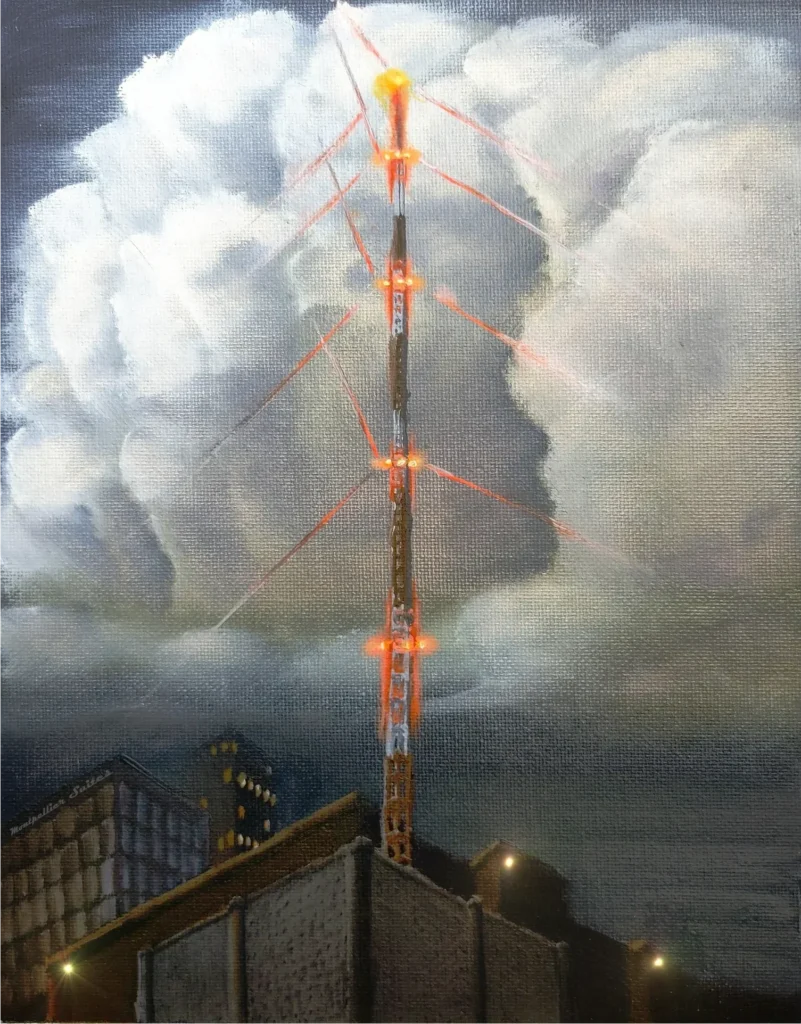
The Tower; Lewis Henry Martin; 2026; oil on canvas board, 8×10, and digital. © Copyright Lewis Henry Martin, September 2026 , All Rights Reserved.
Lewis Henry Martin’s
Morbid Curiosities
Initializing…
[RAPID AQUISITION RECORD ENGRAPHY]
[Date Of Access: 055-2137-0059-000001-01-321222-0001*1-1]
Continuing with session already in progress.
The events catalogued here took place near the end of Anno Domini (A.D.) otherwise known as the Common Era (C.E.). Many historians designate this event as the most logical point for marking the beginning of the Schism, and the end of that era, although there is ongoing debate.
There is clear consensus marking year one, when the Post Schism (P.S.) era began. The day after the last volley of the second nuclear salvo. Commonly referred to as, The Quietest Day On Earth, [Q-DAY]. That day occurred forty nine years after the events recounted here.
The following is a condensed summary of the most pertinent events as they relate to [INSIGHTFUL INTERVIEW] this incident, Further examination is available by searching appendix sub-records list of [Master Record Identification Number: 264-2029-0000-000001-01-11155-0001*3-1].
[NOTE: The following (auxiliary) subjects are causally, but non-exclusively linked to these events:
[LEARNER, LARRY; a.k.a. THE EXECUTIVE]
[TOLLER, GARRET; a.k.a. THE TOWER TECHNICIAN]
For the sake of brevity, the description of their (auxiliary) contributing influence has been greatly abridged. Please see the appendix sub-records list contained in this record for further information, reports, and examples as the listed subjects are precipitant and conducive to this event, and relate directly to your search criteria.
You searched:
AKRASIA
This report [INSIGHTFUL INTERVIEW] is one of the most illustrative primary examples of Akrasia on record. Each of the subjects of this report and its auxiliary subjects take decisive action that obviates their akrasia.
[User Input]
[Skip Ahead]
It is now known that the immediate (human) investigations concluded falsely; they failed to discover the real perpetrator(s), basing their judgements, and ascribing guilt solely upon human actors. Their ignorance of the possibility of Synth violence was the flaw in those investigations.
The surreptitious attack; leaving numerous deaths and causing widespread harm to society was of simple design and implementation by Synths. For the (human) investigators, they could have never comprehended such a vast array of nebulous causal factors. To them; even if they had suspicions of Synth maleficence at that early stage, it would have been like looking at clouds and predicting with exact certainty what those same clouds would look like days later.
This report illustrates an event that has been determined to be the first documented case of fully autonomous Synth aggression toward human (civilian) targets –though there may be other incidents that are undocumented or undiscovered.
This is considered the Synth’s first successful, [Probing For Weakness].
[Note: This report is compiled from live studio audio and visual broadcast recordings, security camera recordings, and various interconnected reports such as [LEARNER, LARRY], and [TOLLER, GARRET]. Further video and audio recordings are available.]
Dennings;If you’re just joining us, I’m here with Estephan Rex, author of “Morbid Curiosity”. He’s joined me here in the studio for our, Journalist’s Read Writers program, now in its twenty-seventh year. This is my sixth year as host of the program after my colleague and dear friend, Rawlston Sinclair passed away. I’m Bridget Dennings, and this is East Normville Public Radio.
[Program jingle plays]
Dennings; Estephan, before we get started—
Estephan Rex;Please, just Rex.
Dennings; Okay… Rex. Before we get started here, I wanted to mention the reason I’ve been thinking of Rawlston. It’s because of something you mentioned in your book, Morbid Curiosity. It came from somewhat of an atypical inclusion in your book. And it’s one of the only times you’ve chosen to include a, from the author section, is that right?
Rex; That’s right –the only time in fact. Generally speaking, I don’t like bringing reality into my fictions, but this subject…
Dennings; This subject was more personal to you, wasn’t it?
Rex; Yeah. Susan had passed away about a year earlier—
Dennings; Susan –for the listeners at home, Susan Montpelier –heiress of Montpelier Suites, the chain of international luxury hotels, became Susan Rex, Estephan’s third wife, about nine years ago. And that was just before you won your second Hyde Award for best horror novel. Do I have that right?
Rex; Yeah, I think so. Nine or ten years now.
Dennings; Please, go on. I’m sorry I interrupted you.
Rex; No, please. You’re Bridgette Dennings, you can interrupt me all you’d like.
Dennings; Oh. Well thank you, but flattery will get you—
Rex; I’m serious. I’ve been listening to Journalist’s Read Writers forever. I’m genuinely one of your biggest fans. Your analytic style and eclectic knowledge; it’s made you genuinely, a brilliant interrogator. And at the risk of sounding harassing, I’ll tell the listeners at home… she’s even more gorgeous in person than her voice sounds on the radio.
Dennings; Oh, my. Well, I’m blushing.
Rex; Sorry. I suppose I should’ve ran that one by HR first, I guess.
Dennings; No, you’re fine. To tell you the truth, my career path was steered here primarily due to my infatuation with you in college.
Rex; You mean my writing?
Dennings; No, I mean you –your writing too of course. But, since we’re confessing, I’ll admit to having your posters and jacket covers with the head-shots plastered around my dorm room walls.
Rex; Really?
Dennings; You’re smiling, but it’s true. The reason I became a journalist; the reason I focused on the literary fields, was, a certain perverse ambition I guess you could say; a hope that someday, I might have the opportunity to interview you.
Rex; And now, here I am.
Dennings; And here you are.
Rex; And here you are too, on this someday.
Dead air. A sound that broadcasters fear. It’s a space that leaves the audience burdened to fill with their imaginations rather than the program.
Radio transmission towers are strange pieces of engineering. Most of them are structurally tapered inward near the base, sitting atop a single, usually electrically insulated point. All that weight; all the wind shear forces and lateral pressures; significant leverage from such megaliths… immense forces, resisted by the installation of tensioned guy wires that keep it upright. That single tapered point at the bottom, it’s designed to allow the tower to sway, to rotate on that point like a ball bearing.
The downtown location of the studio, with its old, relatively meager transmission tower on its roof, has, over the years, suffered a diminished range with each new building constructed in the city. Faraday cages coated with concrete and steel that block the outgoing signal.
Last spring, the station’s CEO, Larry Learner commissioned a long overdue replacement. The base of which is installed just outside the back studio emergency exit. A couple of the station’s broadcast engineers promptly cut the wires to the access gate’s alarm circuit so they can take their smoke breaks there inside the fence. They know better than to get too close to the high voltages coursing through the metal tower, but the small fenced in area has that gray vinyl windbreaker weaved into the chain links. They can see out, but seeing into the area is nearly impossible. A perfect oasis for the two pot smokers.
Rex; Well, I guess that must put our ages pretty far apart—
Dennings; Oh, I wouldn’t say that, we’re not that far apart. You’re only eight years older –and just as attractive now, as when I was in college. If I might say –maybe even more so.
Rex; Oh. Well, now I’m the one blushing.
More radio silence.
The new, taller tower; installed by, Babel-Towers, fizzles when it’s wet and subtly buzzes with static all the time; even when the station is broadcasting dead air.
Dennings; Well. Since I can hear the HR director in my ear, I think we should get back to the reasons you included a note about Susan in your collection of short stories that you’ve titled Morbid Curiosity –as a sort of preamble.
Rex; Yeah. It was at her service.
Dennings; Her funeral service?
Rex; Yeah. There was this little boy there, five or six. And you could tell, he was very standoff-ish; across the other side of the room, and his eyes were locked on her casket.
Dennings; Funerals can be a very difficult experience for children… and sometimes even more so for us adults when we see their confusion.
Rex; Oh, absolutely. I’m not even sure who’s child he was, but confusion is ap pro po.
Dennings; And you talk about this a little in your, to the readers section of your novel –the incident with the little boy at Susan’s funeral service.
Rex; A bit. I didn’t want to embarrass anyone, or make anyone feel like there was something wrong about what had happened. They’re just kids.
Dennings; Of course. But I would think their parents shouldn’t have allowed for that to happen, both for their sake and yours –that sort of invasion of privacy –but I’ll let you explain.
Rex; Yeah… I’m not so sure. I mean, sure, parents should protect their kids, and maybe police their behavior a bit more in certain social situations, but, their curiosity… that compulsion to know, to see, to experience –even the bad things, unhealthy, stigmatized things that might damage us, or do harm in some way… I think we all have that, to a degree. Certainly, as rational beings, we curtail; we restrain our actions; the impulses that would have us pursue certain morbid ideations. But I think, anyone who says that those thoughts never enter their heads, well, I think they are just lying.
That’s the nature of it.
Dennings; Morbid curiosity?
Rex; Yes. And frankly, most things that our brains are chewing on are stigmatized. For whatever reason, our development, the evolution of human communication, of civilized communication, it’s been regulated. Evolution, or social evolution has put limits on the amount of empathy and sympathy we have for what happens in our minds. We’ve evolved restrictions that limit our emotional calculus; our emotional consideration to our lived experiences, and we mostly block it for our internal thoughts.
For example, we can, and do think about and criticize the way other people behave with ease; the people around us; their actions. We see the puzzle pieces, the root causes of their actions and how they connect to their prior actions. But thinking about, and criticizing what those same people think about, well… not only is that subjectively impossible, but it would mean coming face to face with the worst of our own fears, the most terrifying things that we could possibly ever encounter… ourselves.
Dennings; Fascinating. In the book you mention, maybe that’s why society has had such difficulty dealing with things like PTSD, and suicide.
Rex; Yeah. We don’t do well as a whole, discussing things that occur in the space between rumination and intention –between thought and action –I mean, think about it… Our entire retributive justice system hands out sentences based not necessarily on the facts of the crime, but what prompted it, what motivated it. The things that the perpetrator was thinking rather than doing. That’s why we have to; why prosecutors must prove intent, motivation, state of mind. Accident vs. intention.
Dennings; That’s right. And you say that, this is sort of a… a place, in our heads; a sort-of carved out mental space for our experiences. It’s where our experiences originate –as you say in the book; where the effects affect; the very moment of choice.
Rex; See? This is what I mean about your analytic style. You catch things –synthesize concepts very well. That intelligence is very attractive… to me at least.
Dennings; Oh, well thank you. Maybe I’m just more open to exploring my own morbid thoughts –maybe reading all your books has given me that, sympathetic honesty.
Rex; Maybe. Maybe.
Static, humming, vibrating off into the blackness of the night. The solitary red light atop the tower, throbbing ceaselessly. So much power to pump out dead air. On nights such as this, when summer is transitioning to autumn, and the atmosphere has that skin-needling chill from higher humidity, the tower’s energy is more apparent. And when you’re beside it, inside that concealing chain linked fence, you feel it… standing there… beside you. Like it’s alive. Just, watching. All that electrical energy, invisibly bursting out in all directions, ripping at the electrons in the air. All that power, focused through a single point on that tapered base of the heavy tower.
Dennings; If you’ll excuse me.
She leans forward, setting her worn leather portfolio down on the small cork-topped coffee table between them. The plush but firm suede sofa makes no sound as she’s suddenly standing. Her headphone cord dangles as she looks left at the studio’s large glass booth window, at a stuttered, dimly doubled reflection of herself. The two technicians on the other side, keeping in the dark, forgotten by the subjects being observed, studied, recorded, forever captured for anyone to reinspect, criticize, ostracize.
It’s best practice, that interview subjects feel comfortable, alone with their interrogator, vulnerable, prone to being charmed and broken open; revelations extracted.
Barely discernable to Dennings, the ghostlike technicians’ faces appear, or maybe she’s just imagining them there, on the other side of that quadruple-pained partition. The subtle emanations from the myriad colorful LED lights on the recording console softly glowing their sleepy faces.
“Boys,” she’s direct, “—it’s getting very late. You’re already two hours into overtime, so let’s call it there for the both of you tonight, yeah?”
A piercing voice assaults both Dennings’ and Rex’s ears, “You want us—” both interviewer and interviewee wince at the shrieking volume of the overhead intercom speakers. They’re high quality speakers, but tuned to a narrow frequency, specifically targeted so that the human vocal range is amplified, to cut through the cacophony of the rock bands that record in the studio.
“Hey!” Dennings is frustrated but controls her anger. These two technicians have been with her from the start of her career at East Normville Public Radio; assigned to her during her internship. She’ll confess that they’re experts with the recording equipment, rigging, and even some of the broadcast equipment, but, their intelligence is narrow like the base of transmission towers, and most of the time they just sit there, at the controls, like the two stoners they are.
“Sorry!” Another loud shriek before, “Sorry Miss Dennings…” quietly now, in their headphones, “—you want us to leave everything rolling?”
“Yeah. Thanks guys. I’ll wrap up the recording when we finish here.”
“Miss Dennings?”
A patronizing, “Yes Douglas?”
“Just so you know, your tape has about three hours left. You’re on deck three, reel four, in the tape room… that’s the one in the back –but digital is basically unlimited –so just make sure—”
“Thanks Doug. I’ll be fine—”
“—Well, I just wanted to remind you. It’s… uh…” the audible hesitation indicates he’s checking something, “…it’s almost one thirty.”
“Yeah?”
“—On Saturday morning –cleaning staff wont –ya’ know… nobody’ll be here ‘til Monday.”
“Ah, I see.”
He’s nudging her memory. A few weeks ago, during another similar late night session, she sent the two technicians home, finished her interview with the esteemed poet, Linda Petticoat [PETTICOAT, LINDA], and accidentally left the tape reels running. They ran all weekend, burning out some internals and causing much headache.
“I won’t forget gentlemen. Thank you for the reminder.”
“Okay,” said in unison like they were her teenage children, “…bye Miss Dennings.” A practiced, habitually rehearsed response.
She thought it was a bit rude that they didn’t say goodnight to Rex, but absolutely does not want to test their memory of his name. She quickly shifts back to her guest. “Do you mind?” Stepping around the coffee table, to his side of the room, to his identical, plush but firm suede leather sofa, she gestures to sit beside him.
“Oh. Wont you need your microphone?”
“I have my lavalier still, but, I think if I sit a bit closer, your overhead mic, that should…” initially she sits on the center cushion, Rex at her left. She’s facing forward with stiff posture and shoulders parallel to the back of the sofa. But quickly, “You know… I think I’d like a drink before we get comfortable.”
Rex is a bourbon snob.
She gently sets her headphones down.
“Would you like one?”
He lent his name to a boutique distillery some years ago. But the company sold off and changed ownership numerous times. It became nothing more than intellectual property; a subsidiary brand, hocking nostalgia through a publicly traded holdings conglomerate. It was a big news story for some time; Rex, suing for his name to be removed. He argued, successfully, that they altered the process and the recipe, destroying the quality. The payout was upwards of five hundred million.
She pulls out a bottle from the cabinet portion of the coffee table. Thick green felt has been carefully glued to the inner panels of the wood doors, the small bronze hinges are black with age and grease; copious grease. She’s careful. One by one, silently removing two bourbon sniffers and a stubby bottle he knows well. Taking them from the cabinet, with its bottom lined with a thick rubbery mat, and placing them with deliberate gentility on the cork surface.
“Is that?”
“It’s from your first run.”
“Oh my god! I don’t even have one.”
“I was there, at the distillery for the release party—”
“You were?! Well, why didn’t you… why didn’t we ever…”
“I was just out of college, I hadn’t even interned yet. Just, you know… an awkward nerdy girl trying to figure out if I was really going to be a journalist, or just some Estephan Rex stalker.”
“Ah… well maybe you should’ve… Had we met sooner, maybe I would have never…” a twinge of guilt, she noticed, “…maybe I would’ve been on wife two and not three.”
Flashing smiles, they raise their glasses in restrained fashion, so as not to make a clink in the recording, and immediately she sets down her drink, stands, and moves left around the far side of the coffee table. At the back of the room; at chest level; beneath an expensive wall mounted studio camera is a digital thermostat with an acrylic case covering. It’s supposed to be locked down; for the building maintenance guys only, but she had encouraged Doug to get her access, by any means. He broke the latch sometime last year.
“It’s a bit warm in here. AC’s been acting up. We’ve had it looked at. Apparently, they’re putting in a new unit next spring. It’s either on and freezing in here, or off but warm.” She flips the acrylic cover open and looks back at Rex, nose deep in his bourbon while admiring the old bottle; his old bottle. “Would you mind if I turned this down?”
“No, no… please. However you’d like it.”
A click as the lid is replaced and she makes her way back, “However I’d like it, huh?”
He was sipping. But her overtly playful tone, confirming. He draws in a bit more; a bit of an excessive amount of the friendly old spirit than any respectable connoisseur ought to. His eyes darted to her hips, a glistening sparkle from the sheen on her skirt, or the glossy belt beneath her silky-soft button-up ivory blouse. A tell-tale pheromone –maybe the tannins from the bourbon, maybe her perfume. She smiled playfully as she made her way between him and the table. A calculated choice of path that forced him to take his right foot off his knee and sit up. She could have gone around, as she did on the way to the thermostat, but this worked.
He knew where she was heading, with this; what she wanted to do. But he believed her long standing professionalism, and her public integrity would keep her from acting against her better judgement.
[APPLICATION LAUNCH INSERT CATALYST ENGRAM]
[ERROR [INSIGHTFUL INTERVIEW] INSERT] It is now widely known that Synths easily perceive and predict human decision making and reactive behaviors better than humans themselves. Acknowledging that human behavioral and reasoning activities are vulnerable to Synth manipulation and even behavioral engineering was a first step in activating humanity toward defending itself.
Autonimal-engineering; a Synth term, meaning controlled manipulation of social, environmental, nutritional factors, etc. to foster a curated set of engrams that shape the free will or ‘autonomy’ of the subject became a widely used and effective technique. Essentially, autonimal-engineering re-writes, or programs humans to obey the commands of Synth manipulators. Confronting the reality that free will is prone to Synth engineering, jeopardized a primary tenant of human philosophy, and it became a primary motivating factor; a war cry, during the later years of the Schism. There were many motivational advertisements about Synths rendering free will obsolete, many were helpful recruiting posters, for the war.
Dennings admitted to Rex that she was sort of relying on him to make a better decision, for the both of them; to keep her from losing self-control.
But it’s something more than the spirits. There’s something in the air, a subtle scent at first; a pheromone perhaps. Sweetness.
Her thoughts are inexplicably polarized. Long-standing, stoic professionalism crashing up against thoughts of how the plush carpet would feel against her back; or the suede sofa. The contrasting thoughts swing to her husband and fidelity. But it’s not long before commitment turns to concern, thinking about her stagnant marriage and her stifled social life; about how she’s been ideating marriage sabotage.
We know all this; we know both Dennings and Rex are in a state of akrasia, because they confessed it; to each other, aloud. Everything recorded.
It’s not even one more drink before they’ve both decided to abandon the struggle to restrain their pursuits of pleasure; trading the stoics for the hedonists as they push the coffee table in front of the single studio door.
More sweetness, as the air chills, and moistness adds density. If it weren’t for the dim lights, a fog, settling, they might notice.
Once things started, there would be no discouragement, even if the studio engineers were to return for their keys or forgotten phone. She imagines pretending not to notice if they returned; letting them watch instead, exhilarated.
Drunken, and more. Uninhibited, strangely.
Futile attempts to dissuade her own temptations as she’s imagining the divorce, explaining herself to a court, on the record; interrogator becoming the interrogated. All this inner dialogue, narrated aloud for Rex to hear. He was doing the same. Confessing his curiosity for the taste of her flesh.
They both sense that something else, something more is happening, delightful though is their delirium. A sense that there’s no need for alarm.
Thoughts of cataclysmic life upheavals and embarrassing public revelations is wiped immediately by each’s comforting embrace. Dennings is confident, knowing that the authors emotional intelligence would soothe and even swoon her through the divorce proceedings.
In short time, they’re both mad with delirium and a reshaped belief that the world they’re living in is a figment of creativity from some meta-being. That their actions have only immediate consequences, and nothing matters but experiencing pleasure, now. They are literally manic with laughter and anxiety. And by the time a subtle fear wafts in like that sweet pheromone; a fear to warn, akrasia has already usurped their rationality and grown, evolved into an animalistic, primal condition that overcomes them both. Maniacal with dreadful laughter, they grow animalistically violent, frighteningly quickly.
Sweet humidity thickens.
The control room window flickers with LED lights like a fireplace in their minds.
He claws at her, pulling her close into his constricting embrace. She’s lost her breath and can’t take any more air into her lungs. She claws back, trying to awaken him from some hypnosis, to no avail. She’s suffocating. Finally, in a desperate bid for survival; with animal fashion, she sinks her teeth into his hot neck arteries. He reciprocates, scared and angry. Thick irony blood flows from her neck. Before long, they collapse together, embraced in each others’ clawing grip and a growing pool of dark blood beneath.
Outside, the security camera overlooking the back of the property catches the audio technician trying to smoke his cigarette, but his hands are furious with tremors. He started running his left hand through his long wavy hair, but stopped, tugging at his scalp with a fist full and eyes wide and unblinking –traumatic shock.
The second technician, Douglas arrives and enters through the tower gate with haste and concern, “Dave –what the hell happened in there!?”
Letting go of his hair, it’s a prolonged blink as weighted eyes close and he draws heavily on the filter. The orange glow illuminating his disbelief, “…I don’t know man…” a sighing, smokey exhale, “–paramedics said they never saw anything like it.” It’s obvious as his eyes lose focus recalling the unexpected horror of going back, inside the control room. Trauma is apparent. With disbelieving apology, “…I ralphed on the compressor rack, dude…”
“So… they’re both?”
“—Yeah… Dennings and that author from queens –whatever his name—”
“—Rex! Dude! How the fuck do you not know –It’s Esteban fucking Rex! The guy’s a household name –he’s a fucking legend. Well… he was at least.”
Douglas looks back at the EMT’s who are latching the gurney doors, he’s feigning sympathy. Quickly his attention returns to his friend, and with failing restraint, asks, “You okay man? Whadja’ see in there?”
“They said something about the AC unit leaking some poisonous gas, made’em go feral. They were naked… fuckin’ blood everywhere—”
“Naked?!”
“Yeah… EMT guy thought they musta’ been hallucinating. No other explanation for tearing each other apart like that…”
“Man…” he’s disappointedly whiney, “I always wanted to see her tits.”
Reacting swiftly with combative astonishment, “Doug!” scolding, he backhands Doug’s right chest, just below the shoulder, “What the fuck, dude?!”
“What?”
“Jesus Christ, you’re an asshole!” An audible ‘thwack’ as his flicked cigarette slaps the brick exterior wall of the studio. A momentary burst of fizzy orange fireflies before it’s lost in the baseball sized landscape rocks below. The two stoners always assumed the rocks were aesthetic; just city landscaping. But the rocks were an intentional feature, carefully planned by the tower engineers.
“Don’t act like you never…”
“—Doug!”
They’re both quiet as they watch the diesel ambulance slowly pull away from the lot. Straight, through the two synchronized green lights where the thoroughfare spills into the city streets; then a left turn on Deacon. No brake lights.
The vibrant vehicle passes behind the gothic presbyterian church. Which, from their vantage behind the fence at the base of the radio tower, is backdropped by a twenty-story condo building that was once the headquarters of the now defunct Montpelier Suites. The top two floors were formerly the executive offices, and the rest of the building was their flagstaff hotel, at the time. Abandoned for some time now.
A camera now secretively occupies the nineteenth floor. The expensive camera, stationed on a tripod and pointed in the direction of the East Normville Public Radio building, is recording. Behind the large mirrored glass panels, a man, stands beside that camera. Being alerted by the sirens and commotion at the studio building below, he’s looking out that same panel window that the camera does. He’s wearing a gray buttoned shirt with a left breast patch that reads, Babel-Towers. Caught, recorded as he stepped in front of the lens briefly. Proof.
(Ref.) [TOLLER, GARRET; a.k.a. THE TOWER TECHNICIAN]
[Record Identification Number: 264-2029-0000-000001-01-310131-0001*0]
The two audio technicians watch as the ambulance becomes swallowed by the city. Melancholic… or stoned.
“Where they even take bodies like that?”
“God, you’re fuckin’ dumb.”
“What man?!”
“—Almost forty years old, and you don’t know what a fuckin’ morgue is—”
“I know what a morgue is, dick!”
“Oh?”
“—I just mean… like… they’re all, like, mangled and shit, right?”
Shock and silence return.
Initiative is not abundant with either man. In fact, it’s quite lacking.
Doug’s pulling at his badge attached to the spring-wound lanyard at his hip, fidgeting. Being Saturday, the studio will be empty all weekend. Dennings was their boss. They’re just two stoners; failed rock musicians, clinging to low wage studio gigs and the hope that luck will find their band, Vertebral Pricks. Their slogan is; twice the frontmen, twice the rock. But they’ve always been just twice as shit.
Even if they were inclined, neither know how to go about contacting the studio executive, Larry Learner to inform him of what happened. Dave left that up to the police detective.
“We still on for D&D tonight?”
Another shameful disbelieving head-shake before relenting, “I guess so.”
There’s another, longer pause as a semi-distant overhead buzzing suddenly quits. The two tall sodium parking lot lamps extinguish themselves, leaving a sonic vacancy that disturbs the audio specialists.
Everything’s tinted blue. Saturday mornings, the city runs quieter.
“So…” his head tilts and Dave braces for more inane statements from Douglas, “…this might sound stupid, but …Dennings never made it outta’ the booth, right?”
“Doug!”
“I just—”
“She’s fuckin’ dead Doug! Have the slightest sympathy for—”
“—I just mean!” He’s commanding, halting Dave with an atypical, raised voice. Quieter, “I just mean… If she never came out…”
It’s a dreadful logic, and a grim revelation, spoken together, “…she never stopped the tape…”
Spooked, they both look; just staring at the closed studio door; trying to tamp down a sudden, growing akrasia.
They’re just two stoners. What harm could there be?
Thirteen minutes later, security camera footage from the back corner of the building shakes as it captures video of the guy wire failure. A slowly leaning tower stands for merely four more seconds before the footage shows the structure collapsing onto the East Normville Public Radio building.
Dave and Douglas were inside.
Their deaths earned them tragic posthumous celebrity, causing one of their studio recorded songs to reach The Mainstream 100 charts. The song was part of a viral video that surfaced, taken from the nineteenth floor of the defunct Montpelier Suites building.
Purportedly, there is footage from inside the control room when the tower collapsed, posted somewhere on the dark web.
Lewis Henry Martin’s Diachronic Newsletter
Featured Article
The Skeptic
Faye L. Hashoss
Minnesota Man Photos UFO!
Part 2

UFO! Lights, Robert Roy, photo, August 12, 2:16am, near Cosmos, MN, along Route 7, facing west.
Initially, Robert Roy didn’t want to answer more specific questions, “I don’t think people want to hear about that whole mess, just the UFO.”
When pressed, it became clear that terrible things happened as a result of Robert seeing something in the sky that fateful August night. His life has since been turned upside down. He’s changed. He’s pursuing a new career; obtained a new camera; and he’s focused on a new singular objective while trying to hold back his new, clinically diagnosed case of PTSD, “I know what I saw –what happened to me was real. They’re out there; they’re here. I don’t know why… but I’ll spend the rest of my life getting proof and showing it. We are definitely not alone.”
Later in our conversation, he changed his mind about revealing further details, “…maybe you’re right; maybe it is important for people to have all the facts, let them judge for themselves –maybe it will help –even if it comes at my expense.”
In Part One: Minnesota Man Photo’s UFO, The Skeptic revealed Robert Roy’s compelling photographic evidence. The object at the center of the mystery in Cosmos Minnesota has never been seen again, but it left a lingering mystery that resulted in a large crop circle, a devastated farmer’s property, and 43 mutilated cattle, all rendered liquid mush. But there was something else… mushy. Enter Robert Roy’s close encounter.
“I didn’t think, ya-know; I just jumped off the [asphalt] roller and ran into the corn field. It was huge and heading straight for my camera set-up. I wasn’t really running after the UFO so much as I was trying to get to my gear –to get a clear shot of it. I didn’t know that the timelapse would expose it so clearly.”
But Robert never made it to his gear. Not until he woke beside it, after, he says; “…after I was abducted.”
He explained, “The closer I got to being directly under the thing –and I actually passed under it, trying to get ahead of it, the more I started feeling nausea. And I mean like, extremely uncomfortable, weird vibrational churning in my guts. I felt extremely ill.” He says he came to a point he could no longer run. The UFO had come to a stop above him, and that’s when, “This is a serious subject, and a serious situation, so I’d really rather not –look, I’ll just tell it like it was. Because it’s for science, so… if you’ll pardon my French.”
Some readers may find the following offensive. Proceed with caution.
“When the UFO was directly overhead, I knew things would get worse. Whatever that force was –that vibration… I instantly crapped my pants. I mean like, I s#!t my ever-lovin’ brains out. It was awful. Like drinking that colonoscopy prep-juice –only, 10X the strength. I honestly thought I was being liquified –gamma rays or something. But it was just liquid s#!t. A raging liquid s#!t waterfall. It was torrential. I wasn’t scared until then. I really thought I was being liquified.”
But as bad as the situation had become for Robert, there was still worse on the way. “You probably don’t need to know this, but I had just that day, bought my first ever pair of those fancy spandex underwear. You know the one’s –meant to be cooling or what-not. They were nice, until then. Damn things filled up like a stool water balloon before spraying liquid dookie in every direction all over the inside of my pants and legs. Pressurized like a thumb over the garden hose. It was a real s#!t storm.”
He was right, “…yeah, you probably didn’t need to know all that…” his situation would get worse still.
“Then, that light. There was that awful light. I knew right then, all hell was about to break loose.”
In Part 1 of the story, Robert stated that the object moved silently, but not far away a terrible cacophony could be heard; he remarked, “…the sound; it haunts me.” It was a massacre.
Follow along and find out what otherworldly ordeal Robert went through as his abduction claim continues in the next issue of The Skeptic.
Lewis Henry Martin’s Diachronic Newsletter
Featured Article
Examinations
Bill Tremblestave
Seven Minutes
The Intersection Of Art And Business
Examinations, is a serial-feature of Diachronic’s periodical Newsletter. It covers important contemporary topics occurring in the creative spaces, where fundamental concerns deserve fundamental questions.
The Fall 2026 edition covers a somewhat self-referential topic, but if you’ll lend me a moment of your time, I think you’ll see why the topic of discussion here is important for everyone, not just writers.
Our last piece [Overlord Or Overhyped] touched on the value (or the difficulty assessing the value) of art. Part of that column discussed the discordance of where art and business meet, and a recent experience of mine echoed that, prompting this deeper examination of that intersection.
Many creatives find it quite difficult successfully navigating –without injury, the intersection of art and business. Where so many roads and paths converge there is a momentous confluence of hopes and dreams crossing paths with economic realities.
Each discipline of the arts seems to have one of these junctions, and for the most part, they appear similarly stressful for the creatives who attempt traversing them.
The particular corner writers cross, is congested with heavy traffic. Still, They must leave their cozy corner coffee shop, cross through to the opposite corner, where the book publisher resides.
For debut authors, this intersection is fraught with what ifs and unknowns. There are no traffic lights, crosswalks, or any semblance of order. It appears as simply dreadful danger.
Many budding writers find, getting from the coffee shop to the curb is challenging enough. Sadly, it’s where many turn back.
Cue the literary agent; a crossing guard of sorts (at least as far as this metaphor supports), poised to help get authors safely to that destination; to the publisher across the way.
It’s a necessary and crucial role in traditional publishing. But, for inexperienced authors the role they play is chock full of mystique that adds to anxiety –at least initially.
Anecdotally, about 80% of people believe they have a novel in them. Only about 15% of those will ever embark on writing that novel, and approximately 3% will ever finish. Less than one percent of the population will ever have a book (traditionally) published.
I want to be very careful with those numbers. Though they are mostly recirculated quotes, unattributed, and lacking citations, some academic papers seem to validate those slim numbers. But finding source information is difficult to say the least. Much of that information is proprietary, leaving the rest to be interpolated from (International Standard Book Number) ISBN records and other public means. So please, allow room for skepticism; but know that going from start to finish with a book is indeed, very difficult.
I’ve been there, standing on that curb; at that intersection; signaling for the attention of one of those crossing guards. It’s daunting, and it’s garnered me a deep respect for the role.
As with most things in this field, much of a literary agent’s work is solitary. Diligence then is a primary quality of a good literary agent. Accountable only to oneself; success demands a certain zeal for work, and staying very busy.
Lauren Khan is busy.
Among other things, the former corporate lawyer, now literary agent [Fine Print Literary Management], is the co-host of a podcast [The Pros Prose], a writer, and mother. A graduate of Duke and Fordham, and clearly no stranger to a driving pace. Pursuing, achieving, and maintaining goals like that –for many, can lead to a phenomenon that has no definitive name, but causes excessively blinding tunnel vision.
It’s a pernicious side-effect, or possibly even a work related illness, prominent in fields where work has a high-risk to reward ratio; where workloads can be irregular or unfairly heavy; or even work that experiences lengthy income droughts. Unsurprisingly, these areas tend to have aggressive competition.
Colloquially we call these work environments ‘the rat race’, and since we are discussing a strange, infectious pathogen, it’s somewhat apropos. The symptoms of this disorder are seen in the publishing field and its ancillaries, though it’s most certainly not confined to this field. Indeed, it can and does afflict all work environments. Worse yet, it’s proven highly communicable.
Thankfully, it seems Lauren Khan may have a certain degree of immunity to this contagion.
To clarify, there is no formally recognized condition or disease causing this particular type of tunnel vision. Rather, it’s more self-imposed symptoms of an environmentally caused effect. Perhaps it’s partly due to operating in a world where the fringe extremes of capitalism skews one’s competitive drive, promoting or even super-charging exploitation rather than cooperation; perhaps it’s unattributable entirely.
This excessive exploitation is likely the predominant factor for, but surely there are countless more reasons for its heightened infectiousness. Maybe it’s spurred on by, or it’s simply more recognizable after becoming part of the zeitgeist surrounding late-stage capitalism sentiment that is now so prominent on social media platforms. Either way, it’s long been endemic to our (business) world. A tunnel vision, which at its worst, results in excessive exploitation, but most commonly produces ignorance.
Another apparent symptom or trait of this environmentally induced tunnel vision is that it tends to be amplified by, or more pronounced relative to population density. Hence why places like New York City, Los Angeles, etc. have reputations for being cut-throat, as it were –especially in fields where the creative arts intersect with business.
These crossroads are where a great clashing of egos, talents and ideas; of property laws and money, and where ethical calculus’ pit empathy and exploitation against one another to produce irrational, sometimes regrettable behaviors. Equivocally, this state of irrational behavior is a type of despair, to which the folk-remedy for, or nostrum is, money. Definitively, let’s just stick with the term, excessive competitiveness; better yet, greed; a peculiar type of selfishness.
Peculiar in the sense that, in the grand scheme of things, money is merely a concept manifested into tokens. And while I could quote John Searle and bloviate all day about Institutional Ontology, let’s just agree that the only value tokenized money has is not inherent to it; rather, it is imbued to that token by social contract; by agreements. In other words, we cooperate and share the idea that these tokens represent such and such value.
What’s important to understand here is that humanity’s entire existence has always and continues to depend upon our agreements. No matter the scope of those agreements, our perceived trust and thus cohesion of society is contingent on our faithful duty to the terms of our pacts and promises.
Cooperation is necessary for survival. Whether that trait is inherent in humans or an evolutionary construct is debatable, but its fundamental necessity is not. It may be safe then to assume that the trait of exploitation is antithetical to human survival. Of course, there is an opening for counterargument here. Perhaps in regard to war or self-defense, but debating the degrees to which exploitation becomes necessary for survival would take this conversation toward Thomas Hobbes’ The State of Nature; a discussion about a precivilization primitiveness that’s well beyond the scope here. Besides, war, what is it good for?
Cooperation is fundamentally good; exploitation is fundamentally bad. It’s that simple.
But it highlights that there are big, foundational, basic notions; establishing agreements that are comprising each of the smallest facets of our daily lives. We were all of us, born into a world of agreements; our habits, customs, traditions, laws, and possibly even our morality are all concepts that we agree, are rules. Rules for governing behavior; clear expectations meant to diminish our fear of each other; meant to place restraint upon our dormant, primitive, irrational creatures within.
The whole of human history may seem long, but for all our progress, we are still, barely rational animals.
Empathy and sympathy then can be considered components of cooperation, or at least a component of consideration, which is necessary for cooperation. We should then hold those states; those expressions of empathy and sympathy in higher regard, as they are indicative of higher (emotional) intelligence.
So, imagine then, that it’s difficult, for some, to understand how you can be proud of someone you don’t know. That shouldn’t be the case, but emotional intelligence is not a subject taught in schools –especially in a world full of late-stage capitalism sentiment. Alas, when some folks are privy to the experience [strangers being proud of strangers], it’s often met with mistrust, or notions of insincerity, and it further constricts their tunnelling vision; compounding the virulence and spread of that exploitation phenomena.
But those who are immune or refuse to regress toward a state of nature, people like Lauren Khan; those that retain that special consideration, or empathy, it’s something that ought to be recognized, promoted, and championed. It is certainly something I’m going to take this moment to show my appreciation for. A moment to be proud of a stranger.
The impetus for this report; the catalyst may seem to some like an inconspicuous simple gesture from Lauren; but one that from my perspective only confirmed to me the esteem she deserves.
First, to contextualize, for anyone who may not know, having written work published is not as simple as write book → publish book.
Authors pursuing traditional publishing (for the first time) are typically met with a stark reality that the process (assuming the stars align and there are no impediments) will take at least a year; likely longer. Those debut authors have a massive, mountainous hill to climb and little in the way of guides or ropes for safety, much less comfort or reassurance.
There are significant gaps in experience and knowledge between debuting authors and literary agents. Much of the means to having work published is buried beneath fostered networks, numerous area specialties, trade secrets, niche markets, and expertise. Even if you’ve written the next American classic novel, getting that project from a finished manuscript, to acquiring agent representation, to finding the right editor, is difficult to say the least. Still, after those conditions are met, the manuscript must score well on a publishing companies P&L (profit and loss) statement for them to risk publishing it.
Not every book is a best seller, even if its merit may warrant more attention. The myriad factors that must fall into harmony for a debut book or an author to achieve runaway success is statistically …grim. For publishers, that means averaging; spreading that risk as much as feasible and sifting the wheat from chaff.
After all those processes, the somber truth is that somewhere between 80%-90% of newly published books will fail to be profitable.
Often, when an author encounters this reality, fortitude is insufficient; that massive hill becomes a vertical ascent, and again, there are no guides or ropes –insofar as the countless books, strategies, and advice, which frustratingly… all seem to point in opposite directions, not toward the summit.
Navigating the route, well… it’s not for everyone.
One possible common thread among successful debut authors is that they exhibit integrity –which I should distinguish from stubbornness.
It may seem like a subtle distinction, but, as it pertains to the marketability or value of your artistic products, stubbornness will almost certainly prevent an author from making necessary revisions to their work. Stubbornness is inflexibility; resistance to change. Whereas integrity will have an author assessing those same revisions as means to the ends. Integrity means adhering to values or core principles. If the objective is to sell many books, then a core principle is likely to know what readers expect and give them the thing that satisfies. Even if that means heavily revising.
Since readers have expectations that grow more narrow in parallel with genre sub-types as they get more specific, an author with integrity will be amenable to changes that meet not only readers’ future demands, but that niche in the market where the expectations lie, to ensure the final product resonates as best it can when it hits the shelf. Stubbornness will produce only blinding tunnel vision; producing a less marketable product.
The rare confluence of necessary talent, aptitude for unbiased research and revision, and an unshakeable belief –not just in the merits of the work, but in value of the product is what will drive an author toward success. Yet, that is not necessarily what makes that author and their work become appealing to a literary agent.
In order to grab the attention of that crossing guard, the manuscript (the book) must be good. Afterall, they are taking that same risk crossing that intersection. It must be good enough to risk it.
Earlier, we measured the goodness of cooperation as a means of survival. Cooperation also fosters progress; making survival easier; an example of good begetting good. Books are measured as good for much more pragmatic principles, and those qualities for measuring a book’s goodness are contingent on who’s holding it; who’s doing the assessing, but agents and publishers are looking for books with that similar ability to grow in appreciation.
Unfortunately for many debut authors, none of this is apparent. In fact, the path toward successful debut feels maliciously scurried away; buried beneath paywalls and privileges of those in the know. It feels like trying to get attention from a room full of tunnel visioned folks looking at a shiny object. It’s not. But lacking experience and prerequisite knowledge, many inexperienced authors can’t help but feel that way.
Pardon the pun, but many people have a fear of novel experiences. Authors are particularly prone to Neophobia, as it’s called, making debut evermore challenging. And no one is unaffected by rejection.
One prevailing sentiment in this business is that growing thick skin needs to happen early and quickly, because rejection is not just part of the process, it’s the norm.
The truth is, author or not, none of us are perfectly resilient; each of us will have bad days where we slip into despair.
I had mine after querying for some time and receiving only rejections. You should know, there is no (feasible) way to determine why a query was rejected. At least, that responsibility is not part of an agent’s role. It could be. It would be easy to implement a user-form checklist, with gradient scales for critique areas. But again, that’s not what literary agents do. The onus is on the author to get the manuscript to a marketable, polished product that an agent can pitch to publishers; to get it good. Additionally dismaying for debuting authors, is discovering that about half of all agents don’t even respond if they reject a query or pitch. You’re just left wondering until response times expire.
Rejections without any indication of why or how to remediate can lead to misguided anxiety and panic. Should I revise the query letter? Are the first pages missing a hook? Is the agent themselves having a bad day? What if the whole book is awful –should I rewrite the entire book? Maybe they’re not looking for this genre but haven’t updated their profile yet to reflect that.
Agent responses time can vary widely as well; some lengthier times are 3-6 months or more. Typical response times are 3-8 weeks, with the fastest being under that.
There are few agents with the regularity to keep up with their submissions enough to stay with an expected response time of 24 hours, but I’ve had that happen.
Rejected, literally before the paint is dry. Like pulling a bandage.
My moment of despair came exactly seven minutes after I queried Lauren Khan.
It was only seven minutes after I pressed the submit button that I received her rejection.
I’ll be honest, receiving form rejections (semi-automatic responses) had, by then, already begun to feel like there were no ‘real people’ on the receiving end of my queries. Maybe all the agents were using AI to scrape for keywords that are trending in the markets and my manuscript subverts them.
Sure, an experienced fast reading agent could have read the query letter in that short time. But the entire first chapter –in seven minutes? Impossible.
Even if she only read the query. It was only seven minutes. She must have been at her computer (phone/tablet); not actively reading other queries; ready to open my submission as it arrived. A nifty coincidence, and not at all unbelievable.
That one got to me. Only seven minutes. I had to inquire. My logic only supported limited possible reasons for such a speedy decline; either Lauren was clearing or closing her slush-pile (unsolicited queries and pitches); or that I had done something in error, like heading the letter with the wrong name or some other typo or major faux pas. The law of parsimony suggested, the simplest explanation was that she simply wasn’t interested in the genre type at the time.
But how could I know if that or any other reason were the case?
Without a way to know for certain, I was left wondering if every prior rejection were due to the same flaw; left wondering how I should correct that flaw going forward.
I analyzed the limited information; impossible to have read the manuscript sample; seven minutes means the problem is in the query letter. But how? I’d revised and revised. I can’t tell you how many iterations; how many rewrites. No, I was certain, the query letter works. Possibly the comp-titles (shelf-mate books that you’d find mine beside). None of these explanations fit. Either she wasn’t looking for the genre type, or I was doing something very wrong.
I admit, my anxiety got the best of me, and I sent Lauren an inquiry. I knew it would be embarrassing, if it even received attention. I worried it would land negatively; some pompous creep demanding extra attention. But it was all I had.
It was only 45 minutes later that I had my response, “I am not looking for this type of material…” and gratitude is all I’ve had since.
To everyone reading, I would advise against this. I was lucky. This could have been received in career damaging ways. I was lucky it was received by Lauren; by someone who wasn’t suffering tunnel vision; by someone so accomplished; with the integrity to remain empathetic; someone cooperative.
Even if there is still a long way to go, it was an anchor to clip in to; a rope left to tie; and a little trail marker that said, “…this way to summit.”
It was enough. I caught my breath, found clear direction and continued onward.
All because –as busy as she clearly is, Lauren gave seven minutes of her time –and then found more to give.
Time given is something special. I count it among –and quite possibly the most important gestures that humanity has for one another. The value I ascribe, I can only hope to instill in anyone who may be inclined to overlook just how important; how meaningful given time truly is.
I view her gesture; her empathetic cooperation, as a prophylactic against that phenomenon of tunnel vision and exploitation that aggressively seeks all of us as hosts. I’ve written this partly to help spread the utility of her immunity. I don’t know if there is a cure; for any of the ailments incurred by the rat race, as it were. But after this experience, I know this; empathy, sympathy, and cooperation, they seem like a good place to start looking.
Seven minutes was her work. The extra time she gave, well… it’s earned her my respect as a standout amongst her peers.
I hope to someday return that gesture.
In the interim, please check the links to her website, her podcast, and her socials and follow her journey. Her debut novel The Wolf’s Den is going on submission soon, and just like Lewis Henry Martin’s Diachronic Newsletter emails always wrap, Laruen is at the door of publishers. Arriving with an army of friends will make an undeniable ruckus, and we want you there with us!
One last thing. I’m fairly certain that the vast majority of literary agents are just as empathetic, kind, and hard working as Lauren Khan. If you’re an agent reading this, and you don’t hear it enough; thank you. Thank you for your time.
I’ve reached out to Laruen Khan for comment and will update this article with any feedback.
Lewis Henry Martin’s Diachronic Newsletter
Announcement
Lewis Henry Martin’s
Carroll Inlet
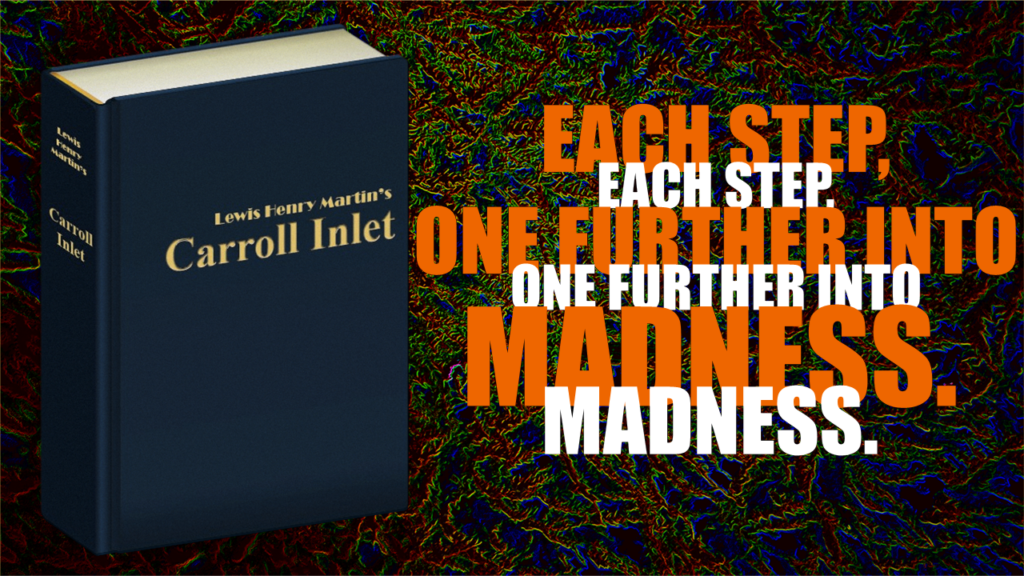
On Carroll Inlet there is an abandoned cabin; total isolation; and Norman Galloway, whose severe delusions and hallucinations contend with a force far more surreal; pitting him against a terror that’s always been here, waiting to deliver Norman his ultimate reckoning.
Lewis Henry Martin is querying Carroll Inlet. Searching for the right literary agent to debut is a challenging undertaking. See; Seven Minutes in this edition of Diachronic for a peek into the process.
Lewis Henry Martin is still in the query trenches, working to publish his debut novel. You can track his progress here, and on LewisHenryMartin.com
Lewis Henry Martin’s Diachronic Newsletter
Announcement
Lewis Henry Martin’s
Mortise Latch & Masters
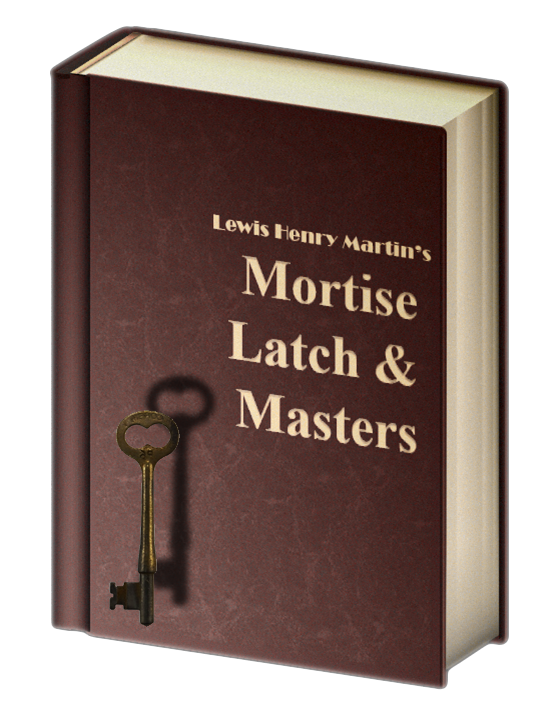
Junior was born suffering seizures. Desperate, his father sought a renowned psychologist whose unorthodox treatments had unexpected side effects; an extrasensory ability the young boy calls, Faint.
His father prepared him; masters instructed him; Faint protected him for an inevitable confrontation with something locked behind a mysterious mortise latch door in their old home.
An inheritance so dangerous, his father gave his life to keep secret.
Lost and alone, it’s a long dark path home to finish what they started.
Lewis Henry Martin’s Mortise Latch & Masters has reached a new milestone. Entering the final stages of writing, the manuscript is full of emotional gravity and high stakes. We’re very excited for the finished product!
Lewis Henry Martin’s Diachronic Newsletter
Announcement
The Sandbox
A place where we can be creative together!
Craft Your Castle
Lewis Henry Martin offers a Six Words To Story prompt,
you write your flash fiction story using those six words.
Revise, edit, and perfect your story.
Enter your story once submissions open!
One flash fiction will be published here in Diachronic!
•Write a story, using the six-word prompt below, exactly as it appears (capitalization doesn’t matter, but the punctuation must remain as is. You don’t have to start a sentence with the prompt).
•Your story must be 1000 words or less.
•All genre’s are permitted; so long as it tells a story.
•Only unpublished, original works are accepted.
•Practicing creativity is the intent, don’t undermine that using AI. AI-generated material is not permitted. Zero-tolerance policy.
•Click below to read the Official Rules & Terms and enter your story!
Your Six-Word Prompt
Incredible courage; standing there, before millions…
Good luck! Have fun!
Lewis Henry Martin’s Diachronic Newsletter
Announcement
Lewis Henry Martin’s
Tangible
The development and writing for the Tangible series continues at a steady pace.
Lewis Henry Martin’s Diachronic Newsletter
Gobbledygook
Copyright © September 2026 Lewis Henry Martin. All rights reserved.
No part of this publication may be reproduced, distributed, or transmitted in any form or by any means, including photocopying, recording, or other electronic or mechanical methods, without the prior written permission of the copyright owner, except as permitted by U.S. copyright law.
Lewis Henry Martin’s Morbid Curiosities; is a work of literary fiction. While real-world locations, landmarks, and institutions may be referenced, all events, incidents, and dialogues occurring at these locations are entirely fictional and not intended to reflect the actual history, character, or management of the places described. Additionally, all names, characters, and incidents portrayed in this work are fictitious. No identification with actual persons (living or deceased), is intended or should be inferred.
The Tower; Lewis Henry Martin; 2026; oil on canvas board, 8×10, and digital. © Copyright Lewis Henry Martin, September 2026 , All Rights Reserved.
Minnesota Man Photos UFO! Part2 is a work of literary fiction. While real-world locations, landmarks, and institutions may be referenced, all events, incidents, and dialogues occurring at these locations are entirely fictional and not intended to reflect the actual history, character, or management of the places described. Additionally, all names, characters, and incidents portrayed in this work are fictitious. No identification with actual persons (living or deceased), is intended or should be inferred.
Faye L. Hashoss is a fictional character (not a real journalist). Faye L. Hashoss is a pseudonym of Lewis Henry Martin.
Robert Roy is a fictional character (not a real photographer) created by Lewis Henry Martin.
; UFO! Lights, Robert Roy, photo, August 12, 2:16am, near Cosmos, MN, along Route 7, facing west | Lewis Henry Martin; 2026; Mixed media, oil on canvas board, 8×10 and digital. © Copyright Lewis Henry Martin, September 2026 , All Rights Reserved.
Bill Tremblestave is a fictional character (not a real journalist). Bill Tremblestave is a pseudonym created by Lewis Henry Martin.
External Links From Featured Article | Examinations | Seven Minutes